VCC vs Pte Ltd Singapore is the first structural question fund managers face when setting up here, and it’s a genuinely different decision from how most operating businesses register.
If you’re setting up an investment fund in Singapore, at some point someone will ask why you’re not using a Variable Capital Company instead of a standard Pte Ltd. For most operating businesses, the answer is that a VCC isn’t built for you at all. But for fund managers, the choice is worth understanding properly.
What a VCC actually is
A Variable Capital Company (VCC) is a corporate structure created specifically for investment funds. Unlike a Pte Ltd, where share capital is generally fixed and changes require formal capital reduction or bonus issue processes, a VCC’s capital is designed to move with the fund’s net asset value. Shares can be issued and redeemed at net asset value without the procedural hurdles a Pte Ltd would face.
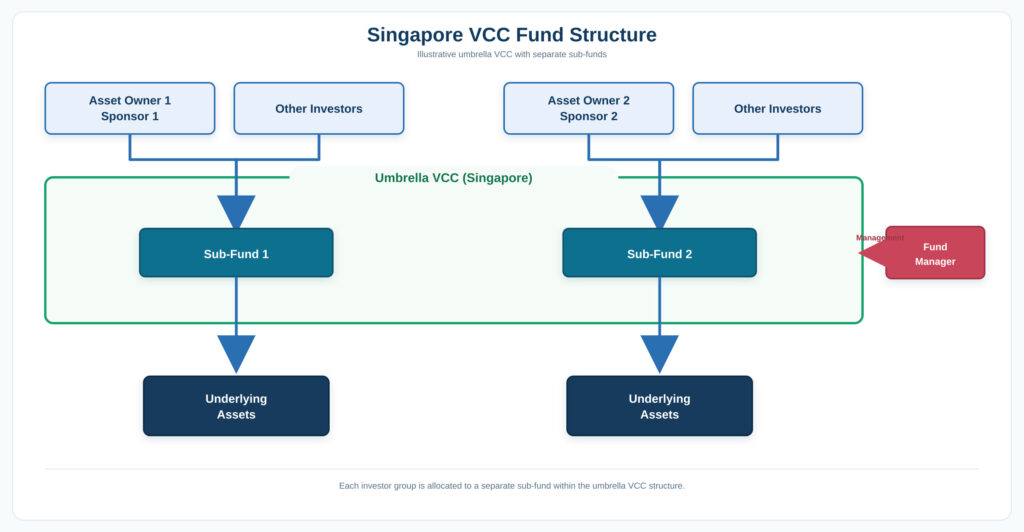
A VCC can operate as a standalone single fund, or as an umbrella structure with multiple sub-funds under one legal entity, each with its own investors, assets, and liabilities. This is one of its biggest practical advantages: a fund manager running several strategies can house them all under one VCC rather than incorporating a separate company for each.
Who actually needs one
A VCC is built for fund managers, not operating companies. If you’re running an actual business, whether that’s a services firm, a retailer, or a manufacturer, a standard Pte Ltd remains the right structure. The VCC only makes sense if you are:
- Launching an open-ended or closed-ended investment fund
- Managing multiple fund strategies and want them under a shared umbrella structure
- Structuring a fund that needs flexible capital (regular subscriptions and redemptions) rather than a fixed capital base
Key requirements
A VCC comes with obligations a standard Pte Ltd doesn’t have:
- A Singapore-based, licensed or regulated fund manager must be appointed
- The registered office must be in Singapore
- A Singapore-resident company secretary is mandatory
- A qualified custodian must be appointed
- At least one resident director is required, who can be a representative of the fund manager
These requirements exist because a VCC is regulated as an investment vehicle, not a general commercial entity, and the Monetary Authority of Singapore expects the governance structure to reflect that.
What it costs
VCC setup is materially more expensive than a standard Pte Ltd incorporation. A realistic first-year budget for a small VCC typically runs from roughly S$134,000 to over S$330,000, including incorporation, legal, and regulatory costs, with ongoing annual costs in the S$83,000 to S$218,000 range after that. Incorporation and legal fees alone often start around S$40,000, which is still considerably lower than setting up an equivalent structure in many offshore or Western fund domiciles.
To help offset this, MAS has run a Variable Capital Companies Grant Scheme that co-funds a portion of eligible costs paid to Singapore-based service providers, up to a cap per application, with a limit on how many VCCs a single fund manager can claim for. Availability and terms of this scheme can change, so check current eligibility before budgeting around it.
Pte Ltd for everyone else
If you’re not running a licensed fund, none of the above applies to you, and a standard Pte Ltd remains the simpler, cheaper, and entirely appropriate structure. The VCC exists to solve a specific problem (flexible fund capital and umbrella sub-fund structures) that operating businesses don’t have.
Not sure which structure fits your situation?
Talk to Abacuscorp about whether your business or fund needs a VCC, or whether a standard Pte Ltd is the right call.