Most SME financial planning happens in a single lane: one forecast, one set of assumptions, one plan for the year. That works fine until something outside your assumptions happens, a key customer delays a large order, costs rise faster than expected, or the market shifts, and there’s no plan B ready to go. Scenario planning and financial modelling is the discipline of building that plan B, and often a plan C, before you need it.
What scenario planning and financial modelling actually involves
Rather than producing a single forecast, this approach builds two or three plausible versions of the future, usually a base case, an upside case, and a downside case, and models how the business’s cash position, profitability, and key decisions would look under each.
This isn’t the same as simply padding your forecast with a margin of safety. It’s a structured exercise in asking: if revenue came in 20% below plan, what would you actually do, and when would you need to decide? If a major cost rose sharply, where would the slack come from?
The three scenarios worth building
Base case. Your realistic, most-likely forecast, built on current trends and known commitments. This is what most businesses already build, even informally.
Downside case. A genuinely plausible negative scenario, not a worst-case doomsday version, but something realistic: a key client delays payment or churns, a cost input rises, a planned deal doesn’t close on schedule. Model what happens to cash runway and profitability, and identify the specific point at which you’d need to act, whether that’s cutting costs, delaying hiring, or drawing on a credit facility.
Upside case. What happens if things go better than expected: a new contract lands earlier than planned, or a cost-saving initiative works better than budgeted. This matters because growth itself can create cash strain, sometimes called the growth trap, and an upside case that isn’t planned for can be just as destabilising as a downside one.
Why this matters more for SMEs than the exercise might suggest
Larger companies often have more buffer, more diversified revenue, and more access to financing to absorb a bad quarter. SMEs typically have less runway and less room for error, which makes it more important, not less, to know in advance what you’d do if things went sideways. Waiting until a downside scenario is actually happening to start planning your response means making decisions under pressure, with less time and fewer options.
Building it without over-engineering it
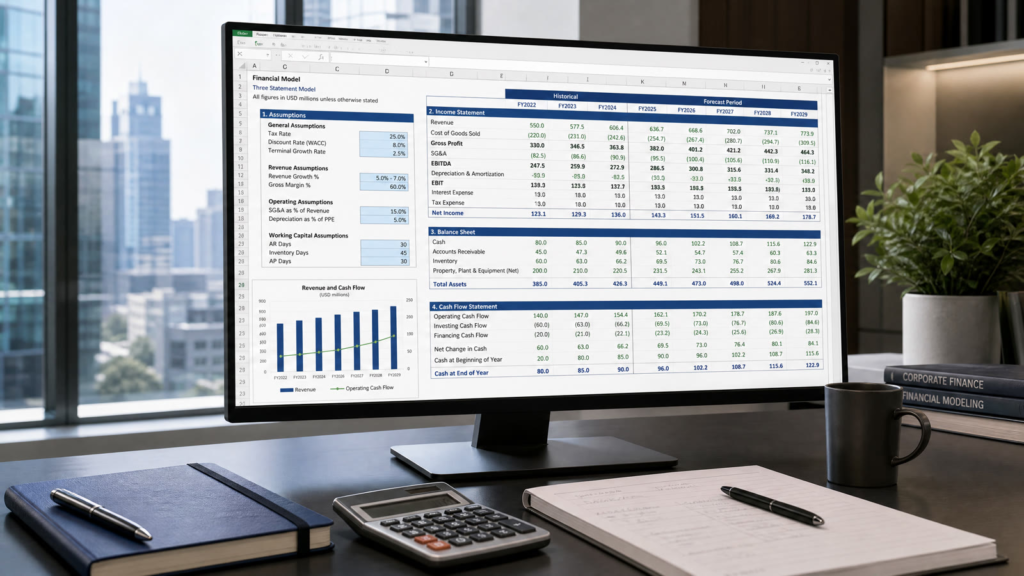
You don’t need a complex financial model with dozens of variables to get value from scenario planning and financial modelling. A simple version, built in a spreadsheet, that flexes your key revenue and cost drivers by a defined percentage under each scenario, and shows the resulting cash position over the next 6 to 12 months, is enough to be genuinely useful. The value comes from the thinking, not the sophistication of the model.
Businesses working with Enterprise Singapore on growth financing or grant applications will also find that having a scenario model ready makes those conversations easier, since funders and lenders often want to see that you’ve thought through more than one outcome.
Making it a living process, not a one-off exercise
Scenario models go stale quickly if they’re built once and never revisited. Reviewing and updating them quarterly, against what’s actually happened since the last update, keeps them relevant and means you’re not caught flat-footed when the environment shifts. Treat scenario planning and financial modelling as an ongoing habit rather than a document you produce once a year and file away.
Want a scenario model built for your business?
Talk to Abacuscorp about building a practical financial model that helps you plan for what might go wrong, and what might go right.