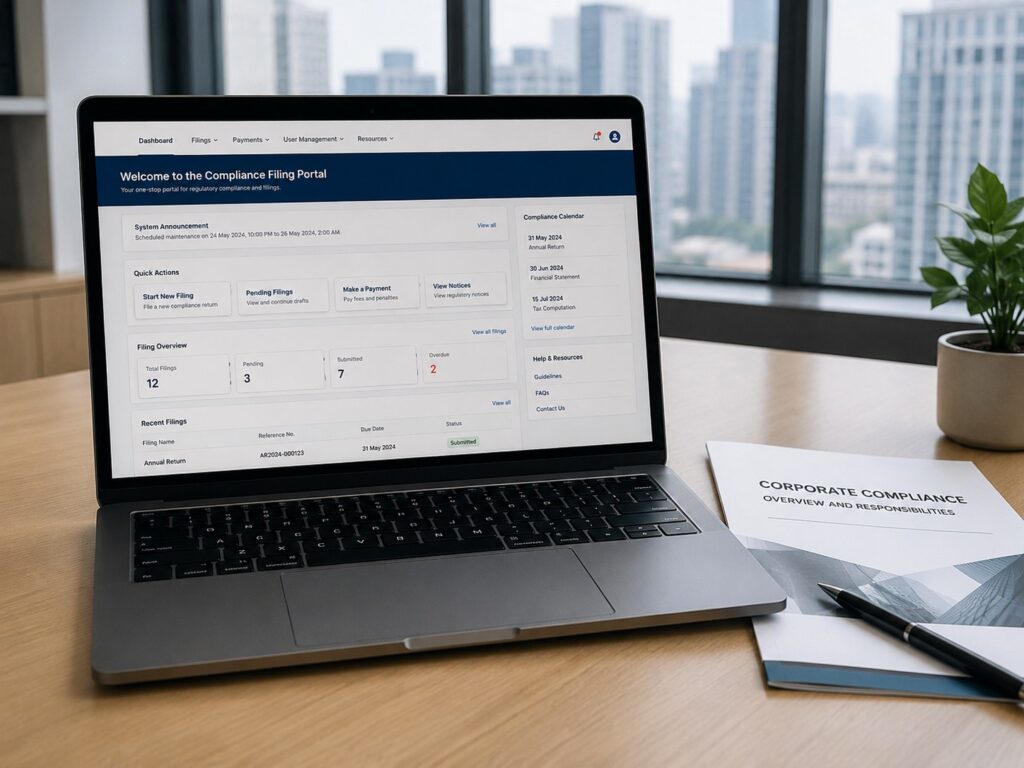
Annual return filing in Singapore is one of the most important recurring compliance obligations for companies here – and one of the most commonly misunderstood. It’s not the same as your tax return. It’s not the same as your financial statements. This guide covers what annual return filing Singapore companies must complete, when it’s due, what happens if you miss the deadline, and how to stay on top of it.
What annual return filing Singapore involves
The annual return is a filing made to ACRA (Accounting and Corporate Regulatory Authority) every year. It confirms that your company’s details on the public register are accurate and includes your company’s financial statements. It covers: confirmation of company particulars (directors, shareholders, registered address, business activities), financial statements in XBRL format for most companies, directors’ statement, and any changes to company information during the year.
Annual return filing is separate from your tax return, which goes to IRAS.
When is the annual return due?
The deadline for annual return filing Singapore companies face depends on whether your company holds an AGM.
Companies exempt from holding an AGM (most private companies): annual return must be filed within 7 months of your financial year end. If your year ends 31 December, filing is due by 31 July. If it ends 31 March, filing is due by 31 October.
Companies that hold an AGM: annual return must be filed within 7 months of the financial year end, or within 30 days of the AGM – whichever is later.
Most private companies take the AGM exemption by sending financial statements to all shareholders within 5 months of year end. If you’re unsure whether your company has been taking the exemption correctly, ask your company secretary.
What you need before you can file
Annual return filing Singapore cannot proceed until the company’s financial statements are ready – this is the most common cause of late filings. Before you can file, you need completed financial statements (income statement, balance sheet, notes), financial statements in XBRL format (prepared by your accountant), a signed directors’ statement, and confirmation of company particulars.
Financial statements must comply with Singapore Financial Reporting Standards (SFRS) and be approved by directors. If your company requires an audit, the audit must be completed first.
ACRA filing fees
ACRA charges a government filing fee for the annual return: S$60 for companies with paid-up capital of S$25,000 or less, and S$175 for companies with paid-up capital above S$25,000. These are separate from your accountant’s and company secretary’s professional fees.
What happens if you miss the deadline
Late filing penalty: S$300 per annual return filed late. This is per return – if you’re two years behind, that’s S$600 in composition fines.
Extended non-compliance: ACRA can strike the company off the register. A struck-off company is treated as dissolved.
Director liability: Directors are personally responsible for ensuring annual returns are filed. Persistent failure can result in prosecution of individual directors.
ACRA monitors compliance and sends reminders before deadlines. If you receive a reminder and miss the deadline anyway, the penalties apply.
Common reasons companies file late
Financial statements not ready: The most frequent cause. If bookkeeping is done quarterly or annually rather than monthly, year-end accounts take longer. Add preparation, director review, XBRL tagging and you can easily pass the 7-month window.
Directors not tracking the deadline: The deadline is based on financial year end, not a fixed calendar date – easy to lose track of without active monitoring.
Change of accountant or company secretary mid-year: Transitions create gaps. The outgoing firm assumes the incoming firm has it; the incoming firm is waiting for records. The deadline passes.
If you’ve already missed the deadline
File as soon as possible and pay the penalty. The longer you wait, the more penalties compound and the greater the risk of ACRA taking further action. If you’re significantly behind – multiple years of unfiled returns – get professional help to get current quickly. It’s manageable, but it requires preparing overdue accounts, filing multiple returns in sequence, and paying accumulated penalties.
For a full overview of company secretarial obligations, see our company secretary Singapore guide.
Need help with annual return filing?
Abacus manages annual return filing for Singapore companies as part of our company secretarial service. If you’re not sure whether your filings are current, get in touch and we’ll check.