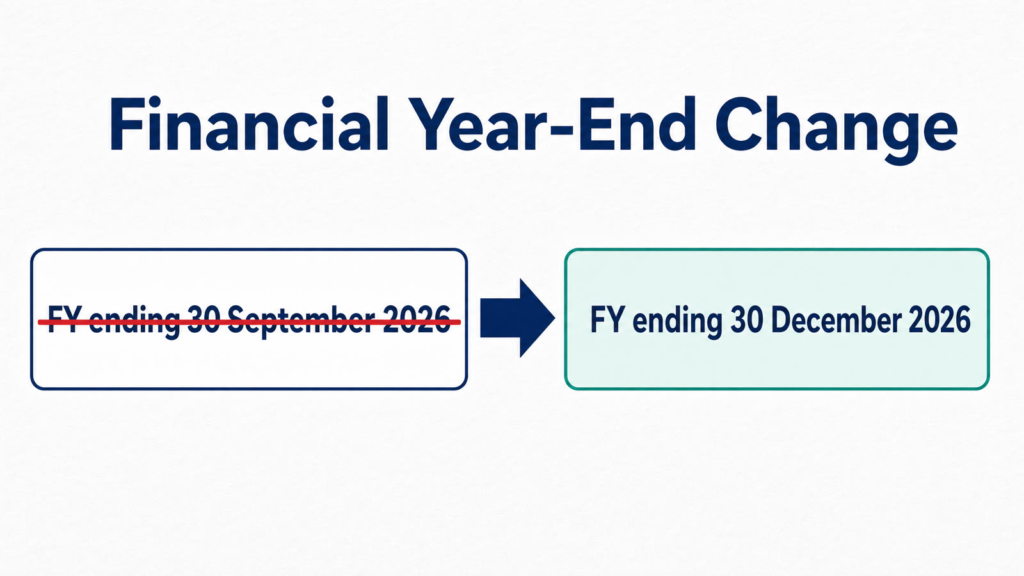
Founders often ask how to change financial year end Singapore rules allow for, and the short answer is yes, within limits. Most companies default to a 31 December financial year end (FYE) without thinking much about it, simply because it feels like the natural choice. That’s not always the right decision for the business, and Singapore does permit a change, provided you stay within ACRA’s requirements.
Why your financial year end matters more than it seems
Your financial year end determines the deadlines for practically everything downstream: your Estimated Chargeable Income (ECI) filing, your annual return, your Form C corporate tax filing, and when your accounts need to be finalised. If your business has a natural busy season, a poorly chosen FYE can mean your accounting and audit deadlines land right in the middle of it, which is avoidable friction.
Retailers with a strong December peak, for example, often prefer a FYE that doesn’t fall immediately after their busiest month, giving the finance team breathing room before closing the books. A professional services firm with a quieter December, on the other hand, might find a calendar-year FYE works perfectly well.
When you can change it
Companies can change financial year end Singapore rules permit, by notifying ACRA, though there are limits designed to prevent repeated shifting of deadlines to avoid scrutiny:
- You generally cannot change your FYE for a financial year that has already been filed with ACRA
- ACRA’s approval is required if the change would result in a financial year longer than 18 months, or if you’ve changed the FYE within the last 5 years and the request isn’t for other permitted reasons
- The change must still comply with the requirement that a financial year not exceed 18 months from the date of incorporation for the first FYE, or 12 months for subsequent ones (with limited exceptions)
If your change falls within the straightforward parameters, it can typically be done through Bizfile+ without needing separate ACRA approval. If it doesn’t, you’ll need to submit a request with justification.
What actually happens when you change it
Changing your FYE affects the length of the financial year in question, either shortening or lengthening it. This has knock-on effects:
- Your ECI and Form C deadlines shift to align with the new FYE
- If the changed year is longer than 12 months, you may need to file more than one Form C for that period, or handle apportionment for tax purposes
- Your audit exemption assessment (based on revenue, assets, and employee thresholds) is measured against the actual financial period, so a longer or shorter year can affect which threshold year applies
This is why a FYE change should be planned with your accountant before you file it with ACRA, not decided and filed as an administrative afterthought.
Common reasons companies change their FYE
- Aligning with a parent company’s financial year, for groups that report consolidated numbers
- Avoiding a year-end that lands during the business’s peak operating season
- Aligning with the calendar year after starting with a non-standard FYE at incorporation
- Simplifying group reporting after an acquisition or restructuring where entities previously had different FYEs
Before you file the change
Talk to whoever prepares your accounts and files your taxes first. A decision to change financial year end Singapore compliance allows for on paper is simple to file, but it can have real consequences for your tax filing calendar and audit exemption assessment, and those consequences are much easier to plan for in advance than to untangle after the fact.
It’s also worth checking whether the change affects any banking covenants, grant conditions, or shareholder reporting obligations tied to your existing FYE, since these are easy to overlook in the rush to file the Bizfile+ update.
Thinking about changing your FYE?
Talk to Abacuscorp about whether a change makes sense for your business, and we’ll handle the filing and the downstream compliance calendar.