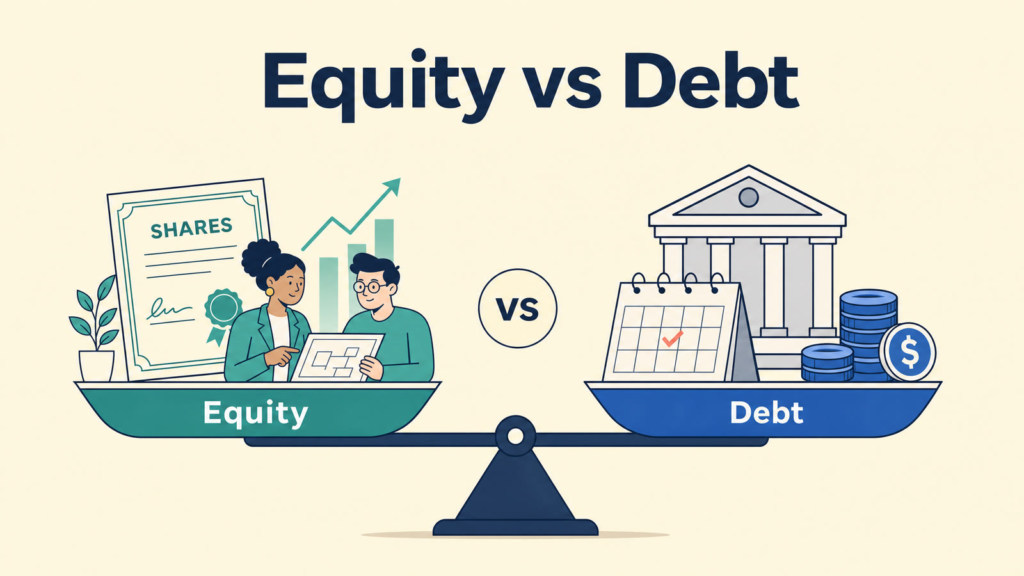
When a growing business needs capital, the instinct for a lot of founders is to default to whichever option feels more familiar: equity for founders steeped in startup culture, debt for more traditional operators. The better question isn’t which one you’re more comfortable with, it’s which one actually fits what the capital is being used for. Getting the debt vs equity financing decision right early can save you from either overpaying for capital or taking on obligations your cash flow can’t support.
What debt is actually good for
Debt, whether that’s bank loans, government-backed SME financing schemes, or working capital facilities, makes the most sense when the capital is funding something with a predictable, near-term return, like inventory, equipment, or working capital to fulfil a confirmed order. It also suits businesses with stable, predictable cash flow that can service regular repayments comfortably.
- The capital is funding something with a predictable, near-term return, like inventory, equipment, or working capital to fulfil a confirmed order
- The business has stable, predictable cash flow to service regular repayments
- You want to keep full ownership and control, since debt doesn’t dilute equity
- The amount needed is moderate relative to the business’s existing revenue and asset base
The tradeoff is that debt has to be repaid regardless of how the business performs. Taking on too much relative to cash flow creates real financial risk, especially if revenue growth doesn’t materialise on schedule.
What equity is actually good for
Equity financing, whether that’s angel investment, venture capital, or bringing in a strategic investor, tends to make more sense when the capital is funding growth with uncertain or longer-term payback, like product development, market expansion, or scaling a team ahead of revenue.
- The capital is funding growth with uncertain or longer-term payback
- Cash flow isn’t yet predictable enough to service debt repayments reliably
- You’re looking for more than capital, an investor’s network, expertise, or credibility can matter as much as the money itself
- The business model requires significant upfront investment before reaching profitability
The tradeoff is dilution and, often, a loss of some control, since investors typically want board representation or approval rights over major decisions.
A simple framework for the debt vs equity financing decision
Ask three questions about the capital you need.
What’s it actually funding? A confirmed, revenue-generating use, like inventory for an order you’ve already won, leans toward debt. An uncertain, growth-oriented use, like building a new product line with no confirmed customers yet, leans toward equity.
Can the business service regular repayments comfortably? If cash flow is tight or unpredictable, taking on debt obligations on top of that adds risk at the worst possible time. If cash flow is stable and the return on the capital is clear, debt is often the cheaper option.
How much control and ownership are you willing to give up? Equity dilutes ownership permanently. Debt doesn’t dilute anything, but it creates fixed obligations that don’t flex if the business has a bad quarter.
Blended approaches are common, and often sensible
Many Singapore SMEs use both: equity to fund the higher-risk, longer-horizon growth bets, and debt, often through government-backed schemes with favourable terms for SMEs, to fund working capital and predictable operational needs. Treating this as a binary choice, rather than a mix suited to different needs within the same business, often leads to either over-diluting ownership or over-leveraging the balance sheet.
What lenders and investors actually look for
Regardless of which route you take, both lenders and investors want to see clean financials, a credible plan for how the capital will be used, and realistic projections. The preparation work, tidy management accounts, a clear cap table, an honest cash flow forecast, is largely the same whether you’re pursuing debt or equity, which is one more reason to get your financial reporting in order before you need either.
Founders who wait until they’re actively raising to sort out their numbers tend to move slower and negotiate from a weaker position. Whichever side of the debt vs equity financing question you land on, the businesses that raise capital most efficiently are usually the ones whose books were already in good shape before the conversation started.
Weighing your financing options?
Talk to Abacuscorp about which mix of debt and equity fits your growth plans, and getting your financials ready to approach either.