Most SME owners track revenue closely and profit loosely, and leave everything else to whatever their accounting software happens to surface. A small, well-chosen set of financial KPIs for SMEs, reviewed monthly rather than glanced at occasionally, tends to catch problems months before they’d otherwise show up.
The financial KPIs for SMEs to start with
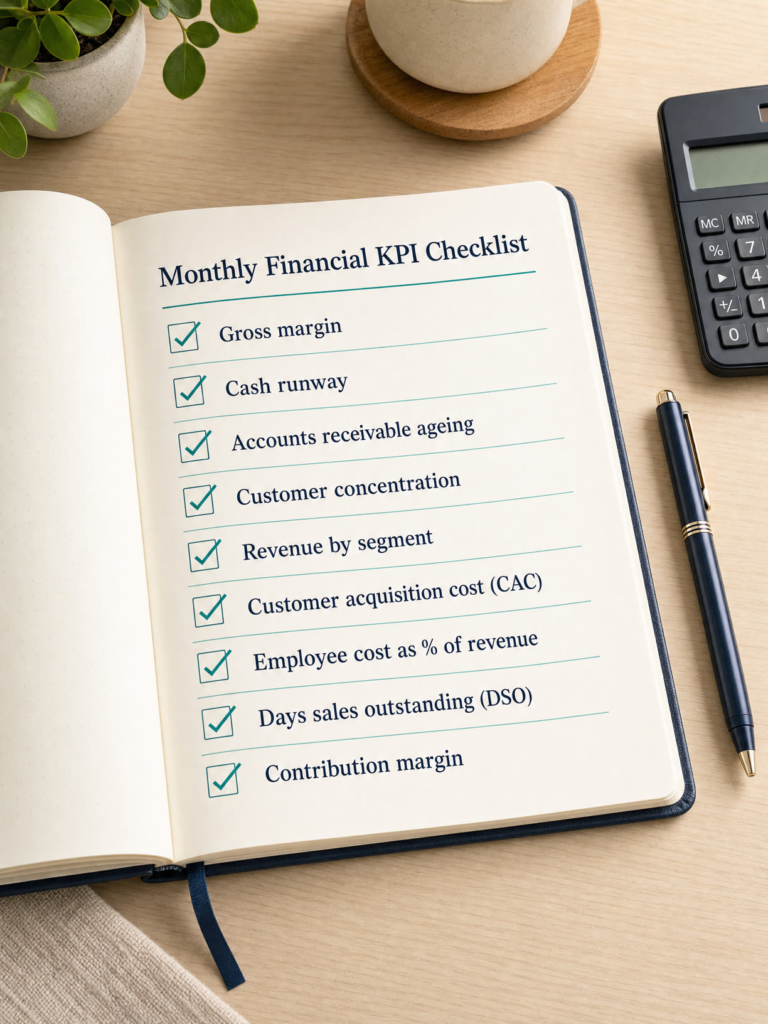
Gross margin. Revenue minus direct cost of goods or services delivered, as a percentage of revenue. Tracked monthly, this catches pricing erosion or cost creep long before it shows up as a full-year problem. A gross margin that’s quietly slipping two or three points over several months is one of the earliest warning signs of a business under pressure.
Cash runway. How many months the business can operate at its current burn rate before running out of cash, assuming no new revenue comes in. Even profitable businesses can run into cash trouble if collections lag behind expenses; runway makes that risk visible before it becomes a crisis.
Accounts receivable ageing. How much money is owed to you, broken down by how overdue it is. A growing balance in the 60-plus or 90-plus day buckets is a leading indicator of a cash flow problem, often before it shows up in your overall cash position.
Customer concentration. What percentage of revenue comes from your largest client, or top few clients. High concentration is a real business risk, not just a nice-to-know statistic, since losing one client can suddenly threaten the whole business.
Revenue by segment, product, service line, or client type. A single blended revenue number hides which parts of the business are actually profitable and which are being subsidised by the rest. Segmented reporting is what lets you make real decisions about where to invest and what to wind down.
A second tier, worth adding as you grow
- Customer acquisition cost (CAC), if you’re spending meaningfully on sales and marketing
- Employee cost as a percentage of revenue, to catch headcount growing faster than the business can support
- Days sales outstanding (DSO), a single number summarising how long, on average, it takes to collect payment
- Contribution margin by product or client, for businesses with multiple offerings at different profitability levels
Why monthly, not quarterly or annually
The value of a KPI comes from catching a trend while there’s still time to respond. A gross margin problem caught in month two is a pricing conversation. The same problem caught at year-end, after twelve months of erosion, is a much larger fix, and possibly a much larger loss.
Quarterly review works for some slower-moving metrics, but cash-related financial KPIs for SMEs in particular need monthly attention, since cash problems can develop faster than a quarterly cycle can catch.
Build a simple dashboard, don’t over-engineer it
You don’t need an elaborate BI tool to start. A single-page monthly summary, pulled from your management accounts, covering these five to eight metrics with a short written commentary on what changed and why, is more useful than a sprawling dashboard nobody actually reads. Add complexity only once the simple version has proven useful and you know what additional detail you actually need.
If you want a broader framework for financial management as you scale, Enterprise Singapore publishes resources aimed at SME growth and management capability, worth a look once the basics are in place.
The habit matters more than the tool
The real value isn’t the metrics themselves, it’s the discipline of looking at the same numbers every month and asking what changed and why. Businesses that build this habit early, around a core set of financial KPIs for SMEs rather than an ever-growing spreadsheet, catch problems while they’re still small and cheap to fix.
Want a KPI dashboard built around your business?
Talk to Abacuscorp about setting up monthly reporting that actually helps you run the business, not just file it away.