Most bookkeeping mistakes don’t show up as a crisis in the moment they happen. They show up months later, at tax filing time, as a scramble to reconstruct what actually happened during the year. These are the common bookkeeping mistakes Singapore SMEs make most often, and what they end up costing.
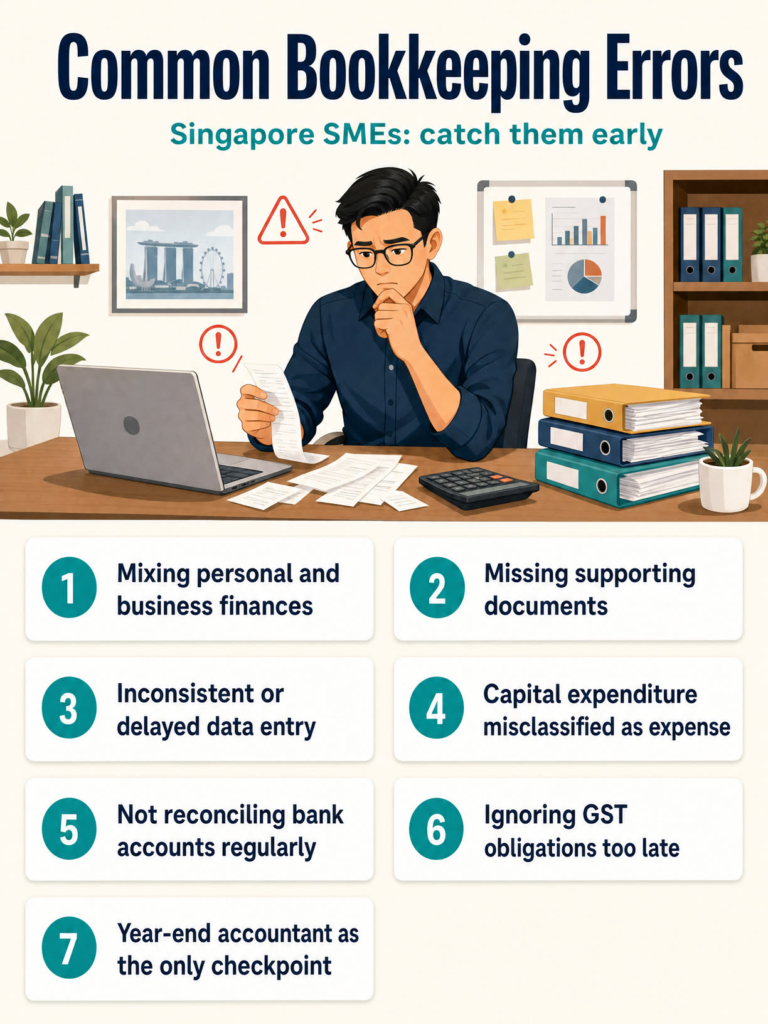
Mixing personal and business finances
This is the single most common issue among newer business owners, especially sole proprietors and single-director companies. Paying for a personal expense from the business account, or vice versa, “just this once,” makes reconciling accounts significantly harder. If it happens repeatedly, it can obscure the true financial position of the business and create complications around what’s actually deductible.
The fix is simple in principle and hard in practice: open a dedicated business account from day one, and route every business transaction through it, no exceptions.
Not keeping proper supporting documents
IRAS and, where applicable, auditors expect supporting documentation, invoices, receipts, contracts, for transactions claimed in the accounts. Missing documentation doesn’t just create audit risk; it can mean a legitimate, deductible expense gets disallowed simply because there’s no paper trail to support it.
A simple habit, photographing receipts immediately and filing them digitally or physically by month, prevents a year-end scramble to reconstruct records from memory or bank statements alone.
Inconsistent or delayed data entry
Bookkeeping done in a rush, once a quarter or once a year instead of monthly, tends to produce more errors: miscategorised expenses, missed transactions, and numbers that don’t reconcile cleanly against bank statements. It also means you’re making business decisions all year without an accurate picture of where you actually stand.
Misclassifying capital expenditure as an expense
Buying equipment, renovating premises, or acquiring an asset with a useful life beyond the current year is capital expenditure, not an immediate deductible expense, though capital allowances can often be claimed over time. This is one of the common bookkeeping mistakes Singapore SMEs make when they’re growing quickly, since equipment purchases and renovations start piling up faster than the books keep pace. Misclassifying this either way distorts your profit figures and can create issues at tax filing when the classification needs to be corrected.
Not reconciling bank accounts regularly
Bank reconciliation, matching your books against your actual bank statements, catches errors, missed transactions, and even fraud early. Businesses that only reconcile once a year at tax time often find discrepancies that are much harder to trace back to their source after months have passed.
Ignoring GST obligations until it’s too late
Businesses approaching the S$1 million mandatory GST registration threshold sometimes don’t track their rolling turnover closely enough, and miss the point at which registration becomes compulsory. Late registration can mean backdated GST liabilities and penalties, on top of the administrative cleanup required.
Treating the year-end accountant visit as the only checkpoint
If the only time anyone looks closely at the books is once a year, when the accountant is preparing statutory accounts, problems that built up gradually during the year, a supplier overpaid, an expense miscoded month after month, compound before anyone notices.
The pattern behind these common bookkeeping mistakes Singapore businesses keep repeating
Almost every mistake on this list gets worse the longer it goes unnoticed. Monthly bookkeeping discipline, proper documentation habits, and a dedicated business account solve most of these before they become tax-time emergencies. Once you know what to look for, common bookkeeping mistakes Singapore SMEs make are far easier to catch early, usually with nothing more than a consistent monthly routine.
Want your books cleaned up before tax season catches you out?
Talk to Abacuscorp about outsourced bookkeeping that keeps your records accurate all year, not just at filing time.