Bookkeeping for startups Singapore founders often get wrong starts with one avoidable mistake: not separating personal and business finances from day one. The most expensive bookkeeping problems accumulate quietly – a few months of unreconciled transactions, missing receipts, unchased invoices – and then the year-end accounting bill is twice what it should be.
Why bookkeeping for startups in Singapore matters
Singapore requires every company to maintain accounting records that explain its transactions and financial position, retained for at least 5 years under the Companies Act. IRAS can disallow expense deductions where there is no supporting documentation during a tax query. Getting this right early is far cheaper than catching up later.
The core principle: separate everything
Open a corporate bank account and use it exclusively for the business. Every dollar of business income goes in; every business expense goes out from it. When your bank statement contains only business transactions, reconciling it is fast and accurate. When it mixes personal and business, every transaction has to be assessed individually and some will inevitably be miscategorised.
What you need to track
Sales and invoices: every invoice you issue – date, customer, amount, whether paid. Track from invoice date, not payment date, so you know your accounts receivable at any point in time. If a client owes you money and it is not in your system, you are less likely to chase it.
Expenses: every business expense needs a record: amount, date, supplier, purpose, and receipt. Categories to track include office rent, staff costs and CPF, professional fees, marketing, business travel, software subscriptions, and equipment.
Bank transactions: every bank transaction needs to be matched to an invoice, expense record, or another transaction. This is bank reconciliation – do it monthly. Leave it three months and you have three months of unmatched transactions to sort through.
GST (if registered): track output tax on sales and input tax on expenses separately. Your accounting software handles this automatically if set up correctly – but the setup matters.
Setting up your accounting system
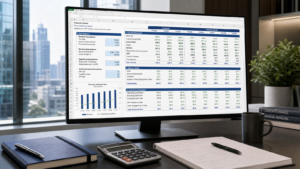
For a Singapore startup, the practical choices are Xero and QuickBooks Online. Both are cloud-based, work well with Singapore banks, handle GST, and allow your accountant remote access. Xero has a slight edge locally because most Singapore banks support its direct bank feed integration.
Do not use spreadsheets as your primary accounting system. They do not scale, do not catch errors automatically, and create reconciliation problems at year end. Set up your chart of accounts correctly from the start – ask your accountant to review the default chart and adjust it to fit your business. Changing it after months of coding is time-consuming and expensive.
Receipts: the discipline that saves money
Take a photo of every receipt immediately and upload it to your accounting system or a receipt app such as Hubdoc or Dext. ACRA and IRAS can go back 5 years. Do not collect physical receipts in a shoebox – they fade, get lost, and are a nightmare to sort at year end. Make this a habit from day one. Retrofitting a receipt discipline after 12 months of missing records is expensive.
Month-end: what should happen every month
At minimum by the end of each month: all invoices for the month raised and recorded, all expense receipts captured and coded, the bank statement reconciled with every transaction matched, outstanding invoices older than 30 days reviewed and chased, and GST records updated if registered. This takes 2–3 hours if you have kept up with it throughout the month. Far longer if you have let it accumulate.
What your accountant needs from you
Your accountant will periodically need: bank statements (monthly), expense receipts and invoices (ongoing), payroll records (monthly), and details of significant transactions such as asset purchases or large receipts. The better organised you are, the less time they spend sorting out basics and the more time they spend on things that add value – and the lower your accounting bill.
Understanding bookkeeping basics is the foundation, but it sits within a broader picture of accounting obligations for Singapore companies. For a complete overview of what accounting services Singapore startups and SMEs need, see our accounting services Singapore guide.
If you would rather focus on running your business than on bookkeeping, Abacus offers bookkeeping services for Singapore startups and SMEs, including cloud accounting setup, monthly bookkeeping, and GST filing.