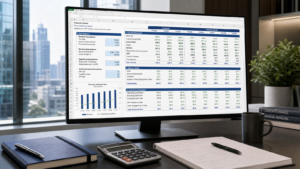
Management accounts investors examine are not the same as statutory accounts, and the distinction matters more than most founders realise. Investors see a lot of financial reporting. Most of it is technically accurate and practically useless: dense spreadsheets, inconsistent formats, numbers with no narrative, metrics that don’t connect to business decisions. When you’re raising or have existing investors, the quality of your financial reporting affects how they perceive your management capability. That is why building a good management dashboard for reporting to investors and boards alike is critical.
What goes into the management dashboard for your investors
The standard for monthly investor reporting is a management accounts pack. At the minimum it should include:
P&L with actuals vs budget
Not just actuals — actuals compared against your budget, with a brief explanation of material variances. “Revenue was S$20K below budget because the Jurong contract was pushed to next month” is more useful than a number sitting on its own.
Balance sheet
Updated monthly. Investors look at this to understand your asset base, liabilities, and working capital position. Many founders only prepare a balance sheet at year end, which is too infrequent.
Cash flow statement and cash position
Current cash balance and a 3-6 month forward projection. If your cash runway is getting short, investors need to know before it becomes a crisis.
Key operating metrics
The financial statements don’t tell the whole story. Include the 3 to 5 metrics that actually drive your business — customer count, average revenue per customer, gross margin by product line, sales pipeline, headcount. Choose the ones that connect most directly to your P&L.
The narrative matters as much as the numbers
A numbers-only management pack is a red flag. It suggests the management team either can’t explain the numbers or doesn’t want to.
Every monthly report should have a short commentary section — one page, no more — covering:
- What happened this month (highlights and lowlights)
- What drove any significant variances to budget
- What you’re watching in the next 30 to 90 days
- Any decisions or support needed from investors
Clear, concise, and honest is better than comprehensive. Investors who sit on multiple boards read a lot of these — make theirs easy.
Consistency builds trust
One of the most common mistakes is changing your reporting format every quarter. It makes it hard for investors to track trends, creates suspicion that you’re hiding something, and makes the reporting process more expensive because you’re rebuilding from scratch each time. Lock in a format and stick to it.
What your accounting system needs to support this
You can’t produce good investor reporting from bad books. The accounting foundation needs to be right first:
- Month-end close happening within 10 to 15 working days of month end
- A chart of accounts that maps to how you want to report (not just how IRAS wants to see it)
- Revenue recognised correctly — not when invoiced, but per your revenue recognition policy
- Accruals done properly so the P&L reflects the period’s actual activity
If your books are prepared quarterly for tax purposes and you’re trying to report to investors monthly, you have a structural problem that needs fixing before the reporting can improve.
Common formats investors expect
Board pack: Prepared for board meetings (quarterly or more frequently for active investors). Includes management accounts, key metrics, operational update, and decisions requiring board approval. Usually 10 to 20 pages.
Monthly update email: Shorter, less formal, sent between board meetings. Often just a one-page summary of key numbers and material developments. Low effort for you; high value for investors.
Data room (for fundraising): A structured set of historical financials, the financial model, and supporting documentation that investors access during due diligence. This relies on the same underlying financial infrastructure as your ongoing reporting. For SGX-listed companies, formal disclosure requirements apply — but even private SMEs benefit from adopting similar standards of rigour.
The CFO’s role in investor reporting
Building and maintaining investor-quality reporting is a core CFO function. It requires financial judgment — knowing what to include, what to explain, and how to present information that’s honest about challenges without being alarmist. The cost of one deal closing at a lower valuation because investors lost confidence in your financial reporting typically exceeds a year’s worth of CFO fees.
For most Singapore SMEs without a full-time CFO, investor-grade management accounts are one of the clearest areas where outsourced CFO support pays for itself. If your reporting isn’t where it needs to be, our CFO as a Service Singapore page explains how we help businesses build the financial infrastructure that supports both day-to-day management and investor confidence — from management accounts through to board packs and fundraising readiness.