Hiring a foreign employee in Singapore means picking the right one of the work pass types in Singapore employers can apply for, and the categories are defined largely by salary and skill level, not by job title or how important the role feels to your business. Getting this wrong at the application stage costs time; getting it wrong after hiring costs a lot more.
The Three Main Work Pass Types in Singapore
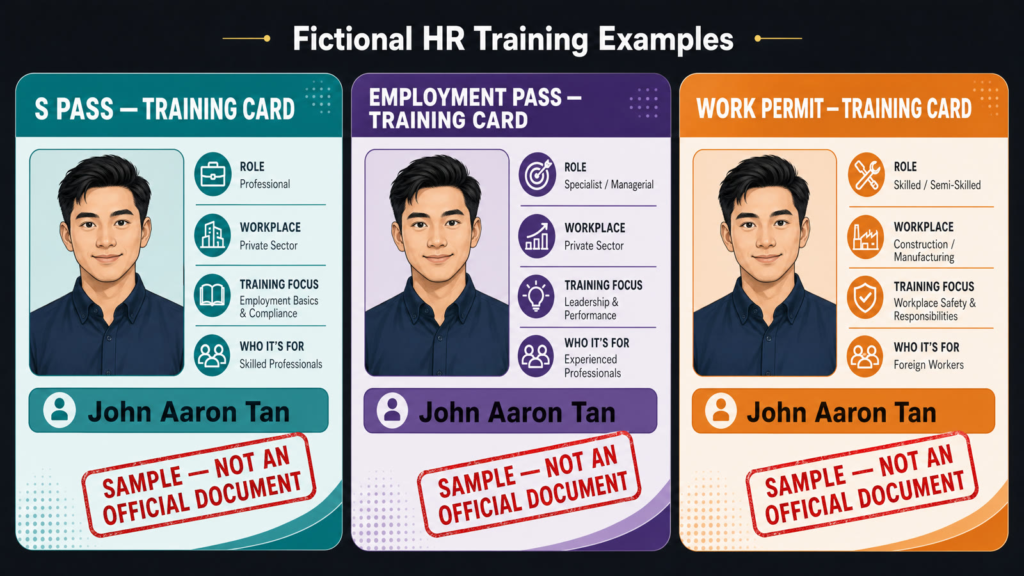
There are three categories most employers will encounter, Employment Pass, S Pass, and Work Permit, and each is aimed at a different skill and salary band.
Employment Pass (EP)
The Employment Pass is for professionals, managers, and executives. As at 2026, candidates generally need to earn at least S$5,600 a month to qualify, rising to S$6,200 for financial services roles. The salary threshold isn’t flat across all ages either; it scales upward for older, more experienced candidates, since MOM benchmarks EP salaries against what a comparably experienced local professional would typically earn.
Since September 2023, EP applications are also assessed under the COMPASS framework, a points-based system that scores the application on salary relative to the local benchmark, the candidate’s qualifications, the employer’s proportion of local hires and workforce diversity, and whether the role supports skills transfer. Applicants generally need at least 40 points across the framework to qualify, and a higher salary alone doesn’t automatically guarantee a pass.
S Pass
The S Pass targets mid-skilled roles that don’t meet the EP salary threshold but still require some level of technical skill or qualification. For renewals from 1 September 2026 onward, the entry-level threshold is S$3,300 a month for general sectors, or S$3,800 for financial services, again scaling upward with age. A further increase is scheduled to take effect from January 2027, raising minimum thresholds further.
S Pass holders count against a quota, the dependency ratio ceiling, that limits how many can be employed relative to your local workforce, and each S Pass attracts a monthly levy payable by the employer.
Work Permit
Work Permits are for semi-skilled and unskilled workers, generally in sectors like construction, manufacturing, marine, process, and services, where MOM maintains sector-specific rules on source countries, quotas, and levies. Unlike EP and S Pass, there’s no fixed minimum salary threshold in the same sense, since Work Permit roles are assessed primarily on sector and worker classification rather than a salary benchmark.
Choosing the Right Work Pass for a Role
The starting point isn’t “what pass do I want to apply for,” it’s “what does this role actually pay and what skill level does it require.” If the salary and role genuinely sit in EP territory but you apply for an S Pass to save on levy costs, or vice versa, you risk the application being rejected, or worse, approved incorrectly and creating compliance issues down the line.
A useful check: benchmark the role’s salary and responsibilities against what a comparable local hire would be paid and expected to do. Reviewing the different work pass types in Singapore against your actual headcount plans, rather than assuming the pass you used last time still fits, avoids most of these mismatches. If MOM’s assessment suggests a mismatch between the pass applied for and the actual role, expect delays or rejection.
Costs to Plan for Beyond the Pass Itself
S Pass and Work Permit levies are a genuine monthly cost per foreign employee, on top of salary, and vary significantly by pass type, sector, and skill classification. These should be budgeted as an ongoing cost of employing foreign workers under these passes, not a one-off application fee.
Quota limits mean you can’t simply hire as many S Pass or Work Permit holders as you want; your foreign worker headcount under these passes is capped relative to your total workforce, which affects hiring plans well before you get to the application stage.
Rules Change Frequently
Salary thresholds, levy rates, and quota rules are reviewed and adjusted periodically, sometimes with lead time before they take effect and sometimes announced closer to implementation. If you’re planning to hire foreign employees, check current Ministry of Manpower (MOM) requirements before finalising an offer, rather than relying on rates from a prior year.
Hiring foreign talent and need the pass strategy right?
Talk to Abacuscorp about structuring your foreign hiring plan, including pass selection, levy budgeting, and quota planning.