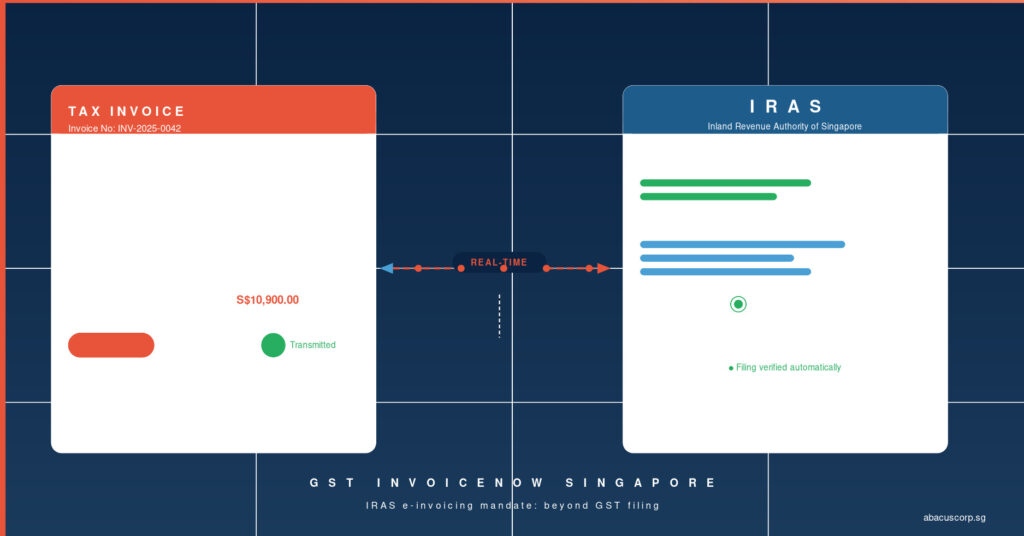
GST InvoiceNow Singapore is IRAS’s phased mandate requiring all GST-registered businesses to transmit invoice data to the tax authority in real time, as each invoice is issued. Most business owners have heard of it. Far fewer understand what it actually requires, or why filing your GST return correctly is no longer sufficient on its own.
This article explains what GST InvoiceNow Singapore mandates, who it affects and when, and what businesses using non-approved software need to do.
What GST InvoiceNow Singapore actually requires of your business
InvoiceNow is Singapore’s nationwide e-invoicing network, built on the international Peppol standard and introduced by IMDA in 2019. The GST InvoiceNow Singapore mandate, which IRAS is now making mandatory in phases, takes this a step further.
Here is the part that surprises most business owners: this is not simply about sending electronic invoices to your customers. It is about transmitting your invoice data directly to IRAS at the point of issuance, automatically and in real time.
When you issue an invoice through an InvoiceNow-ready solution, a structured copy of that invoice data is routed through the Peppol network to your customer and simultaneously transmitted to IRAS. IRAS receives your invoice information as you do business, not just when you file your GST return.
That distinction matters. The traditional model: you issue invoices, keep records, and report aggregate figures to IRAS every quarter. The GST InvoiceNow Singapore model: every GST invoice you issue is visible to IRAS in structured digital form on the day it is issued.
GST InvoiceNow Singapore rollout timeline
The requirement is being introduced in phases, starting with new registrants and moving progressively to existing businesses.
- 1 November 2025: Businesses that voluntarily registered for GST within six months of incorporation must comply.
- 1 April 2026: All new voluntary GST registrants, regardless of when they were incorporated, must use an InvoiceNow-ready solution from the date of GST registration.
- 1 April 2028: New compulsory GST registrants plus existing businesses with annual taxable supplies not exceeding S$200,000.
- 1 April 2029: Existing businesses with annual taxable supplies up to S$1,000,000.
- 1 April 2030: Existing businesses with annual taxable supplies up to S$4,000,000.
- 1 April 2031: All remaining GST-registered businesses with annual supplies exceeding S$4,000,000.
IRAS will notify existing GST-registered businesses of their mandatory date by mid-2026. You can also use IRAS’s InvoiceNow resources to determine your applicable date in advance.
Voluntary vs compulsory registrants: who gets hit first
Voluntary registrants – businesses that chose to register for GST despite being below the S$1 million revenue threshold are in scope first. If your business voluntarily registered for GST on or after 1 April 2026, GST InvoiceNow Singapore compliance is a condition of registration from day one.
Compulsory registrants – businesses required to register because they crossed the S$1 million threshold come into scope from 1 April 2028 onwards, with the schedule depending on annual turnover.
Existing businesses registered before 2026 have until 2028 at the earliest. But the software selection, onboarding, and process changes take time, and the earlier phases have already shown that under-prepared businesses find compliance harder than expected.
What “InvoiceNow-ready” actually means
Not all accounting software qualifies for GST InvoiceNow Singapore. Your software must be an IMDA-approved InvoiceNow-ready solution that:
- Connects to the Peppol network as a registered Access Point
- Issues invoices in the PEPPOL BIS Billing 3.0 structured XML format
- Automatically transmits the prescribed invoice data to IRAS when a Peppol invoice is sent
Invoices issued in Word, Excel, PDF, or through non-approved accounting software do not qualify. Even accounting software that handles your GST filing correctly may not be InvoiceNow-ready if it lacks Peppol connectivity and IRAS data transmission capability.
Software confirmed as InvoiceNow-ready includes Xero, QuickBooks, Financio, ABSS, AutoCount, and SQL Accounting, among others. Verify any solution against IMDA’s official InvoiceNow-ready solutions list.
What businesses need to do to comply with GST InvoiceNow Singapore
Step 1: Confirm your implementation date. Use IRAS resources or wait for your notification (expected by mid-2026 for existing registrants). For new voluntary registrants from 1 April 2026, the requirement applies immediately.
Step 2: Assess your current software. Check whether your accounting or invoicing software appears on IMDA’s approved InvoiceNow solutions list. If it does not, you cannot meet the requirement without switching or adding a compliant solution.
Step 3: Get a Peppol ID. You need a Peppol ID from an accredited Access Point provider before you can use the network. This is a prerequisite for compliance.
Step 4: Migrate to an approved solution. Select an InvoiceNow-ready accounting system, migrate your data, and update your invoicing workflows. Allow two to three months for data setup, testing, and staff training.
Step 5: Tighten your invoicing processes. The invoice data transmitted to IRAS must be accurate. Manual corrections or ad hoc adjustments made after the fact need to be resolved before data starts flowing automatically.
Why GST InvoiceNow Singapore changes your compliance relationship with IRAS
Under the current system, IRAS sees your GST position when you file. Under GST InvoiceNow Singapore, IRAS sees your individual invoices as you issue them. Any discrepancy between your invoicing activity and your GST return becomes immediately detectable.
This is the compliance shift that most coverage understates. IRAS is implementing this partly because it allows far more efficient and accurate GST auditing, and any gaps between actual invoicing and filed returns will be visible in ways they simply are not today.
Consequences of non-compliance
IRAS has indicated it will take an education-focused approach in early phases, with enforcement tightening as the rollout progresses. Consequences include:
- Fines of up to S$5,000 per offence for failing to transmit required invoice data
- Potential denial or delay of GST registration for new voluntary registrants
- Heightened audit risk as IRAS cross-references invoices against filed returns
- Restrictions on government procurement for non-compliant suppliers
Government grants to offset transition costs
IRAS and IMDA have introduced several support measures for businesses making the switch:
- A grant of up to S$1,000 for SMEs to cover operational costs of adopting InvoiceNow-ready solutions
- Early adopter grants of up to S$5,000 for qualifying businesses
- Productivity Solutions Grant (PSG) covering up to 50% of eligible software subscription costs
- Free InvoiceNow-ready solutions available for newly incorporated businesses until March 2031
Check PSG eligibility before committing to new software. The subsidy can meaningfully reduce your transition costs.
Preparing for GST InvoiceNow Singapore as an existing registrant
Even if your mandatory date is 2028 or later, the preparation involved is not trivial. Accounting system migrations, Peppol onboarding, staff retraining, and process changes all take time. Businesses that start twelve months before their mandatory date consistently have smoother transitions than those that leave it to the last quarter.
If you are unsure whether your current software qualifies for GST InvoiceNow Singapore, or you want to understand what a transition would involve, that is a practical question worth answering now rather than under time pressure.
Abacus can help you assess your current setup and prepare for the GST InvoiceNow Singapore requirement. Get in touch to discuss what is involved for your business.